
For UK ETF investors, Lightyear vs Trading 212 is a close call on cost. Neither charges commission or account fees on ETFs, and both offer a flexible Stocks and Shares ISA with FSCS cover. The main differences are elsewhere. First, currency conversion costs 0.1% at Lightyear against 0.15% at Trading 212. Then there are card deposit fees and account types, since only Trading 212 offers a SIPP.
Comparing options? Take the decision workbook with you.
- The ETF Comparison Workbook — 10 pages: the 7-filter framework for choosing between two good funds
- + 2 bonus PDFs: ETF Starter Kit and Dividend Starter Sheet
- + a free lesson from the €147 Masterclass
Lightyear vs Trading 212 at a glance
Both are app-first brokers aimed at long-term investors. Both let you buy ETFs without paying a trading commission, and both pay interest on uninvested cash. So the decision is less about headline price and more about the details. These include which currency your ETFs trade in, how you fund the account and which tax wrappers you need.
All figures below are for UK clients and come from each company’s own pricing and help pages, accessed in September 2026. However, Lightyear’s European entity (for EU clients) has a different price list, which we cover further down.
Buying ETFs: commission and FX
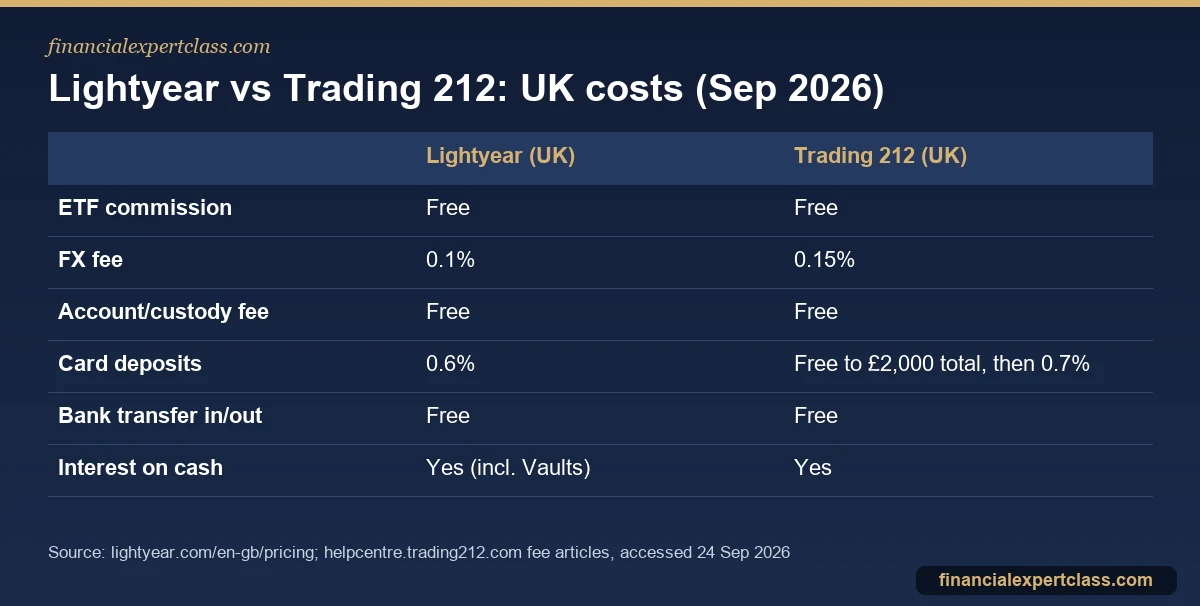
Commission. Lightyear’s UK pricing page lists ETFs as free, with “no execution or custody fees”. It also shows free order execution for US, UK and EU stocks. Meanwhile, Trading 212’s help centre says the only fee it can charge in Invest, ISA and SIPP accounts is the FX fee. Trading commission and custody are free.
FX fee. This is where the two differ. Lightyear charges 0.1% on currency conversion, using the live interbank rate. Trading 212, on the other hand, converts at the spot rate plus a 0.15% FX fee, including for orders placed inside Pies. Trading 212’s help centre adds that the FX fee does not apply to dividend payments.
In practice the FX fee only matters if you convert currency. Say you buy London-listed ETFs quoted in pounds, such as the sterling lines of iShares Core MSCI World or Vanguard’s S&P 500 ETFs. Then neither broker converts anything, and both are genuinely free to trade. On a £10,000 purchase of a US-dollar ETF, the difference between 0.1% and 0.15% is £5. Our comparison of broker FX fees shows how these compare with other platforms.
Lightyear’s own comparison table uses competitor data dated 3 June 2026. It lists Trading 212 with the same 0.15% FX fee and free ETF commission. So both companies agree on how the costs line up.
Taxes still apply. Commission-free does not mean tax-free. For example, Trading 212’s help centre notes the 0.5% Stamp Duty Reserve Tax on purchases of London-listed shares (ETFs are exempt). It also notes the PTM levy of £1.50 on trades over £10,000. These are government and market charges, so they apply at Lightyear too.
Funding the account
Bank transfers in and out are free at both. The difference is cards:
- Lightyear charges 0.6% on deposits by debit card, Apple Pay or Google Pay.
- Trading 212 lets you deposit by card, Apple Pay or Google Pay for free until you have paid in £2,000 in total. After that, it charges 0.7%. Bank transfers and instant bank transfers stay free.
If you fund by bank transfer, as most regular investors do, neither costs anything. For Trading 212’s other charges, see our breakdown of Trading 212 fees for ETF investors.
ISA, SIPP and account types

- Stocks and Shares ISA. Both offer one, and both describe it as a flexible ISA. That means you can withdraw and replace money in the same tax year without using more of your £20,000 allowance. At Lightyear, HMRC rules mean ISA cash must stay in pounds. As a result, buying a dollar or euro ETF inside the ISA triggers the 0.1% FX fee. Lightyear also accepts ISA transfers in, including in-specie (moving the holdings without selling).
- Cash ISA. Both offer one. Lightyear advertised 3.75% AER on its Cash ISA in September 2026.
- SIPP. Trading 212 offers a self-invested personal pension, and it claims basic-rate tax relief automatically. At the time of writing, Lightyear’s UK site listed a Stocks and Shares ISA, Cash ISA, general investment account and business account. However, it listed no SIPP.
- Multi-currency. Lightyear’s general investment account holds GBP, USD and EUR. That avoids converting back and forth if you trade in one currency repeatedly. Trading 212 also supports deposits in multiple currencies.
If you are still deciding which wrapper to use, our overview of ISAs, LISAs and SIPPs for ETF investors explains the allowances.
Interest on cash
Both brokers pay interest on uninvested cash. Both also do it partly by placing that cash in qualifying money market funds (QMMFs), which you must agree to. In September 2026, Lightyear advertised up to 3.84% AER through its Vaults product and 3.75% AER on its Cash ISA. It noted that Vaults rates are variable and shown after its fee of 0.15% or less. Trading 212, for its part, pays interest daily on uninvested cash in Invest, ISA, SIPP and CFD accounts, with no minimum balance. Its current rates for new clients are on its terms page and in the app. Rates change often, so compare them on the day you decide rather than relying on any article.
Safety and regulation
For UK clients, both are FCA-regulated and both fall under the Financial Services Compensation Scheme:
- Lightyear UK Ltd has FCA authorisation and regulation (FRN 987226). Its help centre says it keeps client assets separate from the company’s own. Uninvested cash sits with Citibank, NatWest and a Federated Hermes QMMF. In addition, FSCS investment protection covers up to £85,000 per person if the firm fails and there is a shortfall.
- Trading 212 UK Ltd also has FCA authorisation and regulation (FRN 609146). It keeps client money in segregated accounts at banks including J.P. Morgan and Barclays. Custodians including BNY Mellon and Interactive Brokers hold the assets, and FSCS investment protection is up to £85,000 in total.
Neither scheme protects you from falling markets. Our review of whether Trading 212 is safe goes deeper into its structure.
For EU investors
Outside the UK the comparison changes. Lightyear Europe AS, regulated in Estonia, showed a different price list on its EU pricing page in September 2026. ETFs were still free, but there was a 0.35% FX fee. Stocks cost €1 per order for euro-denominated shares, £1 for UK shares and 0.1% (maximum $1) for US shares. Trading 212 serves EU clients through Trading 212 Markets Ltd (Cyprus) and Trading 212 EU GmbH (Germany). For Cyprus-entity clients, its help centre cites Investor Compensation Fund cover up to €20,000. So check which entity you would join before comparing.
Which should you choose?
- Choose Lightyear if you regularly buy dollar or euro ETFs in a general account and do not need a SIPP. It gives you the lower 0.1% FX fee and a true multi-currency balance.
- Choose Trading 212 if you want an ISA, a SIPP and a Cash ISA in one app. It also suits you if you like its Pies and AutoInvest tools, or fund by card occasionally (the first £2,000 is free).
- Either is fine if you buy sterling-listed ETFs by bank transfer inside an ISA, because the cost difference is effectively zero.
For the full picture on each, read our Lightyear review and our Trading 212 review.
Frequently asked questions
Is Lightyear cheaper than Trading 212?
Only for currency conversion. Neither charges commission or an account fee on ETFs, but Lightyear’s UK FX fee is 0.1% against Trading 212’s 0.15%. For sterling-listed ETFs bought by bank transfer, the cost is the same.
Does Lightyear have a SIPP like Trading 212?
Not at the time of writing. In September 2026, Lightyear’s UK site listed a Stocks and Shares ISA, Cash ISA, general investment account and business account. Trading 212, by contrast, offers a SIPP.
Are Lightyear and Trading 212 ISAs flexible?
Yes. Both describe their Stocks and Shares ISA as flexible. So you can take money out and put it back in the same tax year without using extra allowance.
Is my money protected with Lightyear and Trading 212?
For UK clients, both are FCA-regulated and in the FSCS. It covers up to £85,000 per person if the firm fails and client assets are missing. However, it does not cover investment losses.
Cited sources: Lightyear UK pricing, Lightyear: how are my assets protected?, Lightyear: ISA help, Trading 212: fees in Invest, ISAs and SIPP, Trading 212: funding fees, Trading 212 UK: funds and assets protection, and Lightyear Europe pricing. Verify current fund figures before investing. Educational content, not financial advice.
Not personalised financial advice. Verify your situation with a qualified adviser. Operated by Aurum Digital Marketing LTD (UK), Companies House 15203665.
European UCITS/ETF investor with 11+ years building a global dividend and index portfolio, and founder of Financial Expert Class. I write every guide here from first-hand experience investing across EU brokers and tax regimes — not theory. More about me →