
Norway taxes ETF gains and dividends at an effective 37.84%, not the 22% headline capital rate — Skatteetaten multiplies share income by an upward-adjustment factor of 1.72 before the 22% rate applies, and that factor is unchanged for 2026. Two reliefs pull against it: the shielding deduction, and the aksjesparekonto (ASK), which defers Norwegian tax entirely for as long as you leave your money invested.
Fortunately, Norway also gives investors two valuable counterweights. The shielding deduction shelters a slice of your returns from tax each year. Meanwhile, the share savings account lets you defer tax entirely while you stay invested. In this guide I walk through how it all fits together, with a worked example and the mistakes I see most often.
How the Norway ETF tax system is built
Norway separates income into two broad streams. Ordinary income, such as salary, is taxed at one rate. Share income, such as ETF gains and dividends, follows the shareholder model known as aksjonærmodellen.
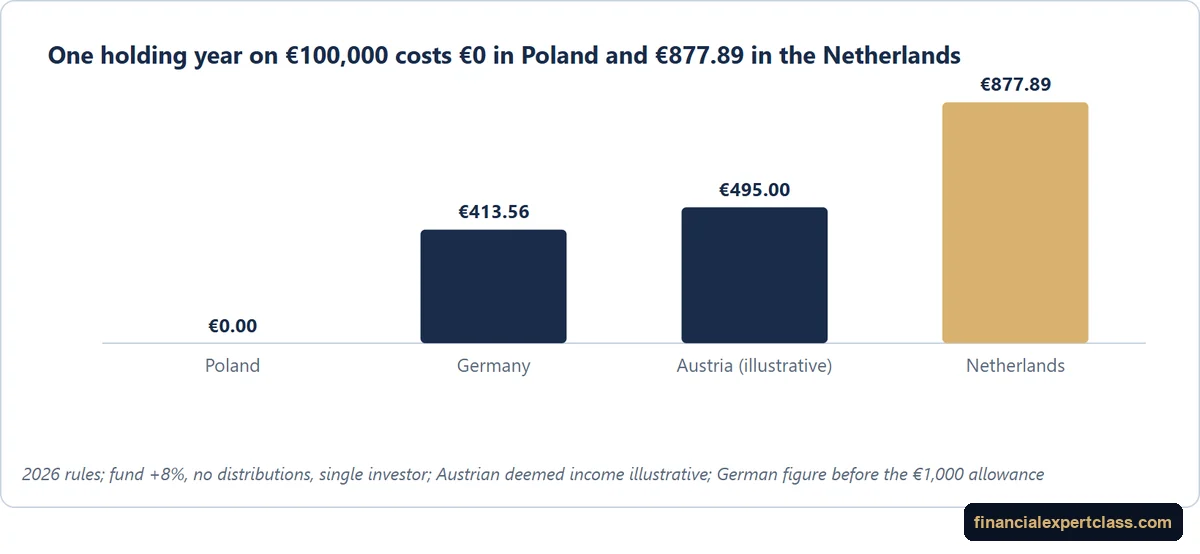
Every European country taxes ETFs in one of four ways. One map shows which is yours, and why the same €100,000 ETF costs €0 a year in Poland and €877.89 in the Netherlands. The full lesson, free, no sign-up.
Read the free lesson →Under this model, your share income is not taxed at the raw capital rate. Instead, the tax office multiplies it by an upward-adjustment factor first. Only then does the capital rate apply. As a result, the true burden on equity returns climbs above the headline figure.
Why the effective rate beats the headline 22%
Norway’s general capital income rate is 22% for 2026 (18.5% in the Troms and Finnmark action zone). Share income, though, is adjusted upward before that rate bites, and the resulting effective rate on share gains and dividends is 37.84%.
The mechanism works in two steps. First, the tax office takes your net share income for the year. Then it multiplies that figure by an adjustment factor set above one, lifting the taxable base before applying the 22% rate.
The factor is not an estimate: Skatteetaten publishes it as exactly 1.72, and states the resulting tax on shares as 37.84%. So a NOK 10,000 share gain becomes a NOK 17,200 taxable base, 22% of which is NOK 3,784 — 37.84% of the gain you actually made. The factor is unchanged from 2025 to 2026.
Therefore, never assume your ETF gains face only 22%. That figure applies to interest and ordinary capital income. Equity returns carry the heavier 37.84% load instead.
Why Norway designed it this way
The adjustment is deliberate, not accidental. Norway wants share income and high salary income to face broadly comparable top rates. Otherwise, owners would route earnings through companies purely to enjoy the lower capital rate.
For ETF investors the lesson is practical. Your Norway ETF tax burden tracks the adjusted figure, so plan your cash flow around it. Knowing the real rate also makes the shielding deduction and the ASK feel far more valuable.
The shielding deduction (skjermingsfradrag)
Norway softens this burden with the shielding deduction. In practice, it is a risk-free-return allowance. It exempts a small, calculated portion of your returns from the share-income tax each year.
The tax office sets a shielding rate annually, broadly tracking short-term government interest. Your allowance equals that rate multiplied by your cost basis. Consequently, the deduction is modest in low-rate years and larger when rates rise. The most recent published shielding rate is 3.6%, for income year 2025.
How the shielding rate is set
The rate is not arbitrary. Skatteetaten takes the average yield on three-month Norwegian Treasury bills, adds 0.5 percentage points, subtracts the 22% tax rate and rounds to one decimal. Skattedirektoratet then fixes it in January of the following year, so you always learn the rate in arrears — which is why there is no 2026 shielding rate yet. It arrives in January 2027, and anyone quoting one today is guessing.
This design matters in practice. When interest rates climb, your shielding allowance grows alongside them. When rates fall toward zero, the allowance shrinks and shelters very little.
The allowance is also calculated per holding, not per portfolio. The tax office multiplies your acquisition cost for each holding by the published rate. As a result, a larger cost basis produces a larger annual allowance on that line.
Crucially, unused shielding does not vanish. It carries forward and attaches to the same holding. Later gains and dividends on that holding can then absorb the accumulated allowance, which quietly trims your lifetime tax bill.
The shielding deduction inside an ASK
The shielding deduction also operates within an ASK, though at the account level. Skatteetaten applies the rate to your lowest deposit balance during the year, plus any carried-forward allowance, and that figure shelters taxable withdrawals when they eventually occur. The word lowest is the trap: a large deposit made in December buys you almost no shielding for that year, and a mid-year withdrawal drags the basis down for the whole year.
So the two reliefs stack rather than compete. You defer tax through the account, then shrink the eventual bill through the allowance. For patient investors, that combination is quietly generous.
The aksjesparekonto (ASK): the standout feature
The share savings account, or aksjesparekonto (ASK), is the tool I wish more EU systems copied. You hold equity funds and listed shares inside it, then buy and sell freely without triggering tax on each disposal. The eligibility test is statutory: skatteloven § 10-21 allows listed shares and equity certificates in EEA-domiciled companies, plus units in EEA-domiciled equity funds — defined as a securities fund with more than 80% equity exposure at the start of the income year. Irish- and Luxembourg-domiciled UCITS equity ETFs are EEA funds and qualify; US-domiciled ETFs and bond funds do not. Fund units need not themselves be exchange-listed, and statutory eligibility is not the same as availability — each provider decides what it actually lists.
Instead, tax falls due only when you withdraw more than you originally deposited. In other words, you can pull out your own contributions tax-free at any time. Only withdrawals that dip into your accumulated gains create a taxable event.
This deferral is genuinely powerful. You can rebalance, switch funds, or take profits on a winner without an immediate bill. Meanwhile, the deferred tax keeps compounding inside the account on your behalf.
The withdrawal ordering: deposits first, gains last
The withdrawal ordering is the heart of the ASK’s appeal. Norway treats your deposits as the first money out. Only once you have withdrawn every krone you paid in does the gain portion become taxable.
Picture a simple split. Your account holds NOK 600,000 of original deposits plus NOK 250,000 of accumulated gains. You may withdraw up to NOK 600,000 with no tax whatsoever, because those are your own contributions.
The ordering creates real flexibility. You can fund a large expense from your deposit base without crystallising any tax. Then your gains continue compounding untouched, still sheltered inside the account.
However, the rule cuts both ways. Once deposits run out, every further withdrawal is fully taxable gain. So track your remaining deposit balance, because it defines your tax-free withdrawal headroom.
The rebalancing benefit in practice
Rebalancing is where the ASK earns its keep. In a taxable account, trimming a winner to restore your target weights triggers tax on the realised gain. That friction nudges many investors to drift away from their intended allocation.
Inside an ASK, that friction disappears entirely. You can sell a surging equity fund and buy a lagging one with no immediate tax cost. Your asset allocation therefore stays disciplined, year after year.
The same logic helps when a cheaper fund appears. You can switch to lower fees without a disposal bill eroding the saving. Over decades, that freedom compounds into a meaningful edge.
Which funds qualify for the ASK
The ASK is built for equity exposure, not for everything. It generally covers shares and equity funds domiciled within the EEA. Many popular UCITS ETFs from Ireland and Luxembourg therefore fit comfortably.
There is a nuance for mixed funds, though. A combination fund usually qualifies only if it holds a high enough share of equities, often around four-fifths. Below that threshold, the fund typically falls outside the account.
Moreover, the account is selective by design. Bond funds, money-market funds, and most non-EEA holdings usually fall outside it. So always confirm a specific ETF qualifies before you rely on the shelter.
Norwegian treatment at a glance
| Element | How Norway treats it | Who it suits |
|---|---|---|
| Equity ETF gains | Multiplied by an upward-adjustment factor, then taxed at the 22% capital rate, giving an effective rate in the high 30s. | All equity investors realising profits outside an ASK. |
| ETF dividends | Treated as share income under the same adjusted model, after any foreign withholding. | Holders of distributing ETFs. |
| Shielding deduction | Annual risk-free allowance on cost basis; unused amounts carry forward to the same holding. | Long-term buy-and-hold investors. |
| ASK deferral | No tax until withdrawals exceed deposits; trade and rebalance freely inside. | Active rebalancers and compounders. |
| Eligible holdings (ASK) | Generally EEA-domiciled equity funds and listed shares; bonds and many non-EEA funds excluded. | UCITS ETF investors. |
Illustrative summary only. Rates and adjustment factors change yearly, so verify the current figures with Skatteetaten.
A worked example: the ASK deferral benefit
Imagine you deposit NOK 500,000 into an ASK and buy a broad equity UCITS ETF. Over time the holding grows to NOK 800,000. Along the way you switch into a cheaper world ETF and rebalance twice.
Inside the ASK, none of those trades triggers tax. Your full NOK 800,000 stays invested and keeps compounding. By contrast, a normal taxable account would have charged you on each realised gain during the switches.
Now suppose you withdraw NOK 200,000. Because that sits within your NOK 500,000 of deposits, it is tax-free. Only when later withdrawals exceed your deposits does the gain become taxable, and even then the shielding deduction can reduce it.
The lesson is simple but striking. Deferral keeps more money working for longer, and compounding does the rest. You can model that difference yourself with my compound growth calculator.
A second example: taxable account versus ASK
Now compare two identical investors over ten years. Both invest NOK 400,000 and both rebalance once a year. One uses a normal taxable account, while the other uses an ASK.
The taxable investor realises a gain at each annual rebalance. Each disposal triggers the adjusted share-income tax, so a slice of capital leaves the portfolio every year. That leakage no longer compounds for them.
Meanwhile, the ASK investor rebalances with no tax at all. Their full balance keeps working through every year of the decade. The deferred tax stays invested and continues to grow on their behalf.
Assume both portfolios earn the same gross return and end near NOK 900,000 before any final tax. The ASK investor still owes tax eventually, but only on withdrawn gains. Crucially, they enjoyed a decade of compounding on money the taxable investor had already surrendered.
The gap is not dramatic in year one. However, it widens steadily as the deferred amounts compound. Across a full investing lifetime, that head start can be worth a substantial sum.
My experience helping Norwegian readers
Over eleven years of investing in EU ETFs, I have compared many national systems. Norway stands out because the ASK rewards patience and good housekeeping. Several Norwegian readers have told me it changed how they rebalance.
One reader had been avoiding a needed fund switch purely to dodge a tax bill. Once he moved the holding into an ASK, that fear disappeared. He switched, cut his fund cost, and never triggered a disposal tax.
That pattern repeats often. The deferral removes the tax friction that otherwise traps people in expensive or poorly diversified funds. In that sense, the ASK improves portfolio decisions, not just tax outcomes.
Pre-reporting by Norwegian brokers
Administration in Norway is refreshingly light, and it is a legal duty rather than a courtesy. ASK providers must report to Skatteetaten by 10 February each year under skatteforvaltningsloven § 7-3 — deposits, withdrawals, shielding used and unused, taxable gains and asset values all included. Your tax return therefore arrives largely pre-filled.
Still, you should review it carefully rather than rubber-stamp it. Check that cost bases, foreign withholding, and ASK movements look correct. Errors are rare, yet they remain your responsibility to catch.
For dividends from foreign ETFs, foreign withholding tax may also apply at source. You can estimate that drag with my ETF withholding tax calculator before you choose a fund.
Common mistakes
The first mistake is assuming the 22% rate applies to share gains. It does not, because the upward adjustment pushes the effective rate well above it. Budgeting at 22% leaves an unwelcome surprise.
The second mistake is holding equity ETFs outside an ASK by default. Many investors never open one, then pay tax on every rebalance. Opening the account early avoids years of needless friction.
A third error is ignoring the shielding deduction. Some readers forget that unused allowances carry forward and quietly shelter future gains. Tracking your basis preserves that benefit.
Finally, people often buy non-EEA or bond funds expecting ASK treatment. Those holdings usually do not qualify. Checking fund eligibility first prevents a costly assumption.
Key takeaways
- Share gains and dividends are taxed at an effective 37.84%, not the headline 22%.
- The shielding deduction (3.6% for income year 2025) shelters a slice of returns and carries forward per holding.
- The aksjesparekonto (ASK) defers all tax until withdrawals exceed your deposits.
- An ASK covers EEA-domiciled equity funds with over 80% equity, plus EEA listed shares — not bonds or US-domiciled funds.
- Norwegian brokers pre-report, but you must still check the figures yourself.
FAQ
Q: What tax rate do ETF gains face in Norway?
A: An effective 37.84%. The capital income rate is 22%, but Skatteetaten first multiplies share gains and dividends by an upward-adjustment factor of 1.72, which is unchanged for 2026.
Q: Which funds qualify for an aksjesparekonto?
A: Under skatteloven § 10-21, EEA-domiciled equity funds with more than 80% equity exposure at the start of the income year, plus listed shares and equity certificates in EEA companies. Irish and Luxembourg UCITS equity ETFs qualify; US-domiciled ETFs and bond funds do not.
Q: Can I withdraw money from an ASK tax-free?
A: Yes, up to the total you deposited. The law treats every withdrawal as a return of your own deposits first, so only the amount exceeding your deposits — less any shielding deduction — is taxed.
Q: What is the current shielding rate?
A: The most recently published rate is 3.6%, for income year 2025. Skattedirektoratet sets each year’s rate in January of the following year, so the 2026 rate does not exist until January 2027.
Q: Does foreign withholding tax still apply inside an ASK?
A: Yes. Foreign dividends can face withholding at source regardless of the account. An ASK defers Norwegian tax; it does not override another country’s withholding.
The bottom line
Norway taxes equity returns more heavily than the headline rate suggests, yet it hands investors strong tools in return. The shielding deduction trims your bill a little each year. The ASK defers tax for as long as you stay invested, which is the bigger prize.
Choosing a platform: which Norwegian brokers actually offer an ASK.
If you invest in ETFs from Norway, open an ASK early and keep your holdings EEA-eligible. For the broader principles behind fund choice, read my ETF tax efficiency guide. Then verify the current figures before you act.
Sources, all checked 24 August 2026: Skatteetaten on the upward-adjustment factor, the aksjesparekonto, the shielding rate and general income; skatteloven § 10-21 on ASK eligibility; and Skatteetaten’s third-party reporting guidance. Tax rules change — verify before acting. Educational content, not financial advice.
Norway in context against the rest of Europe: our EU ETF tax comparison table.

European UCITS/ETF investor with 11+ years building a global dividend and index portfolio, and founder of Financial Expert Class. I write every guide here from first-hand experience investing across EU brokers and tax regimes — not theory. More about me →