
Every few weeks I get a variation of the same question: “The British have their ISA, the French have the PEA — what do we get?” It is a fair question, and the honest answer is that Europe is a patchwork. There is no EU-wide tax-free investment account. Instead, each country has built its own wrapper, or built nothing at all, and the quality ranges from genuinely excellent (the UK ISA) to clever-but-fiddly (Hungary’s TBSZ) to non-existent (Germany, the Netherlands, Spain in practice).
I have spent years comparing these because readers of this site live all over the continent, and because I invest from Lithuania, where the “wrapper” is a modest pension scheme rather than a proper tax-free account. This article is the map I wish someone had handed me: what each wrapper does, how much you can put in, what the catch is, and how good it really is.
One caveat first. Tax rules change constantly and I am not a tax adviser. Treat every figure below as approximate and 2026-vintage, and verify the current numbers with your national tax authority or a local adviser before you act. For more detail, see our guide: IG SIPP Fees.
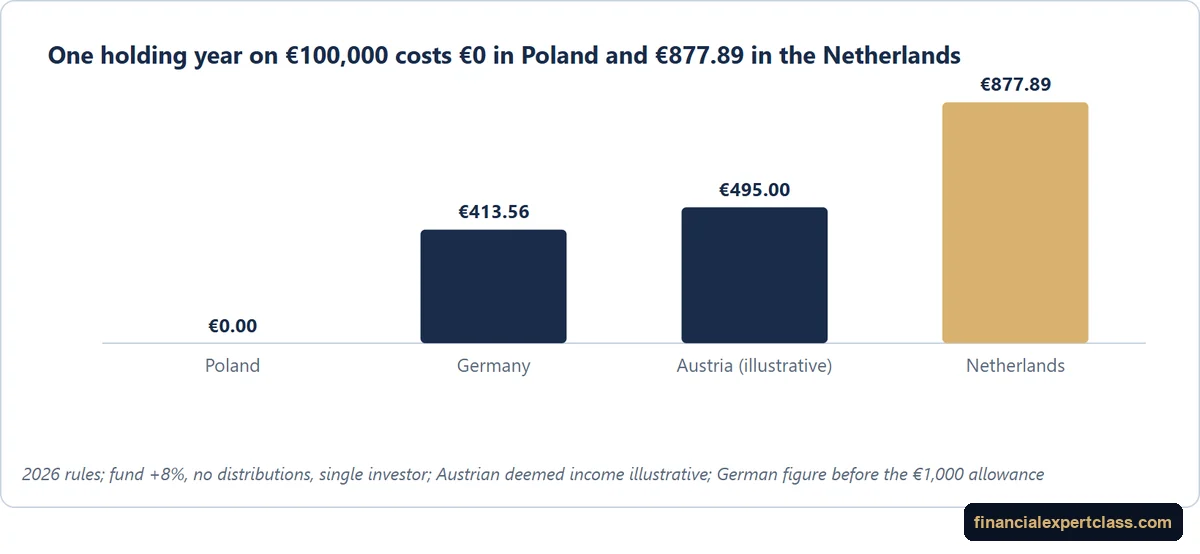
Every European country taxes ETFs in one of four ways. One map shows which is yours, and why the same €100,000 ETF costs €0 a year in Poland and €877.89 in the Netherlands. The full lesson, free, no sign-up.
Read the free lesson →The UK ISA: still the gold standard
Nothing else in Europe matches the ISA. You can contribute up to £20,000 per tax year into a Stocks and Shares ISA, and everything inside — capital gains, dividends, interest — is permanently free of UK tax. There is no five-year holding requirement, no restriction to domestic funds, no exit conditions. You can sell tomorrow, withdraw the money, and owe nothing. The official rules are set out plainly on the UK government’s ISA pages. For more detail, see our guide: Lloyds Share Dealing ISA Review.
How we calculate: see the how we compute tax examples for the exact assumptions behind these figures.
Two practical notes. The allowance is use-it-or-lose-it: it does not roll over. And the ISA only works while you are a UK resident; move to the EU and most countries will tax the gains as if the wrapper did not exist. Investing outside the ISA in a general account also brings a nasty UK-specific complication with accumulating funds, which I covered in my piece on excess reportable income.
France: the PEA, a strong second place
The Plan d’Épargne en Actions is France’s answer, and it is a good one with two strings attached. Contributions are capped at €150,000 lifetime (not per year), and after the plan is five years old, your gains escape income tax entirely — you pay only social charges of roughly 18.6%. Withdraw before the five-year mark and you generally lose the benefit and close the plan.
The second string is eligibility: the PEA is restricted to EU-domiciled equities and funds. French investors get around this with synthetic UCITS ETFs that are legally EU-equity funds but deliver S&P 500 or MSCI World performance through a swap — one of the few places where synthetic replication has a genuine structural advantage. France also has the assurance-vie, a separate insurance wrapper with its own perks; I compared the two in my assurance-vie vs PEA guide. The official PEA rules are summarised on service-public.fr.
Sweden: the ISK, taxation by formula
Sweden took a completely different route. The Investeringssparkonto does not tax your actual gains at all. Instead, the state assumes you earned a notional return — the schablonintäkt, calculated from your account value and the government borrowing rate — and taxes that assumed return at 30%. For 2026 the deemed return is 3.55% (the statslåneränta was 2.55% on 30 November 2025, plus one percentage point), so the levy is 1.065% a year — and the tax-free floor Sweden had been phasing in is now real money: the first SEK 300,000 of savings per person is exempt, doubled from SEK 150,000 on 1 January 2026 and shared across your ISK, kapitalförsäkring and PEPP.
This analysis sits within our ETF taxes in Europe by country.
The beauty of the ISK is behavioural: no capital gains calculations, no tax on switching funds, no paperwork per trade. The weakness is that the tax is due whether your portfolio went up or down. For a long-term equity investor I think the trade is clearly worth it, and I ran the actual numbers in my Swedish ISK tax guide. There is no contribution cap, which makes it unusual on this list.
Hungary: the TBSZ, patience rewarded
Hungary’s tartós befektetési számla is the least known wrapper on this list and one of the most generous. The deal: you deposit money during the account’s opening “collection year”, then let it sit. Hold for five full calendar years and the standard 15% Hungarian capital gains tax drops to zero. Break the seal after three years and you pay a reduced 10% instead.
The quirk is that each TBSZ only accepts deposits in its first year. The standard workaround is to open a new one every January, so you always have a current account collecting contributions while older vintages mature toward tax-free status. There is no contribution cap and no restriction to Hungarian assets — ordinary UCITS ETFs qualify. For a disciplined buy-and-hold investor, this is close to an ISA with a five-year waiting room.
Poland: IKE and IKZE, retirement wrappers that work for ETFs
Poland offers two accounts, both retirement-flavoured. The IKE exempts you from the 19% Belka tax on capital gains entirely, provided you keep the money until age 60 (or 55 with pension rights). The IKZE works the other way around: contributions are deductible from your income tax now, and withdrawals at 65 are taxed at a flat 10%. Annual limits are tied to the average national salary — roughly speaking, the IKE limit sits in the mid-twenty-thousands of złoty and the IKZE limit is about a third of that; both are indexed each year.
The catch: these are retirement accounts, so the benefit evaporates if you withdraw early — though you simply pay the normal tax you would have owed anyway, with no extra penalty, which is more forgiving than most pension systems. Several Polish brokers offer IKE/IKZE brokerage accounts where you can buy UCITS ETFs directly. I walked through the mechanics in my IKE and IKZE guide.
Italy: the PIR, a wrapper with strings
Italy’s Piano Individuale di Risparmio exempts you from the 26% capital gains tax if you hold for at least five years, with contribution limits of roughly €40,000 per year up to €200,000 total. The problem is the composition requirement: a large majority of the plan must sit in Italian instruments, with a slice reserved for smaller companies outside the main index. That turns a tax wrapper into a concentrated bet on Italian small and mid caps — a very different risk from a global ETF portfolio.
My view: the PIR is a reasonable satellite for an Italian who wanted domestic exposure anyway, but it is not a home for a core global portfolio — the tax saving does not justify abandoning diversification. Italians running a standard UCITS portfolio should focus instead on fund selection, which I covered in my guide to ETF investing in Italy.
The big gaps: Germany, the Netherlands, Spain
Now the uncomfortable part. Three of Europe’s largest economies offer no general-purpose tax-free investment account at all.
New for 2026: Slovenia’s new individual investment account.
Germany
Germany has pension products (Riester, Rürup) but nothing like an ISA for ordinary investing. What Germans get instead is a set of softeners: the €1,000 Sparer-Pauschbetrag allowance, and the Teilfreistellung, which exempts 30% of equity-fund gains from the flat ~26.4% tax. An accumulating global ETF held for decades is therefore taxed more gently than the headline rate suggests, but it is still taxed.
The Netherlands
The Dutch Box 3 system taxes deemed returns on total wealth rather than actual gains — structurally similar to Sweden’s ISK, except it applies to everything by default. There is no opt-in wrapper to escape it.
Spain
Spain has no wrapper for ETFs. The famous traspaso regime — switching between funds without triggering tax — applies to traditional mutual funds but, in practice, not to ETFs. Spanish ETF investors simply pay capital gains tax on the standard savings-income scale when they sell.
In all three countries, the playbook is the same: use accumulating ETFs to defer tax as long as possible, use whatever annual allowance exists, and accept that the wrapper you are looking for does not exist.
Europe’s tax wrappers at a glance
| Account | Tax benefit | Caps (approx.) | Main restriction | My verdict |
|---|---|---|---|---|
| UK ISA | Fully tax-free, forever | £20,000/year | UK residents only | Best in Europe |
| France PEA | No income tax after 5 yrs (social charges remain) | €150,000 lifetime | EU funds only (synthetic ETFs solve it) | Excellent |
| Sweden ISK | Flat notional tax (1.065%/yr in 2026) above a SEK 300,000 tax-free base, no gains tax | None | Tax due even in down years | Very good for equities |
| Hungary TBSZ | 0% tax after 5 full years; for a contract opened from 1 Jan 2025, 18% after 3 and 28% before that | None | Deposits only in opening year | Underrated gem |
| Poland IKE / IKZE | No 19% Belka tax (IKE); deductible in, 10% out (IKZE) | ~PLN 28k / ~PLN 11k per year (2026; IKE PLN 30,099 in 2027) | Locked until 60–65 for the benefit | Very good for retirement |
| Italy PIR | No 26% gains tax after 5 yrs | ~€40k/yr, €200k total | Heavy Italian-asset requirement | Satellite only |
| Germany / NL / Spain | No general wrapper | — | Allowances and deferral only | Use accumulating funds |
All figures approximate and subject to change — confirm current limits with your national tax authority before contributing.
What I’d do in each situation
If your country offers a wrapper, my advice is blunt: fill it first, before investing a single euro in a plain taxable account. The lifetime value of compounding without tax drag is enormous, and most people underuse these accounts out of inertia. A Brit should max the ISA. A French investor should run their core through the PEA with synthetic world ETFs. A Swede should hold equities in the ISK without overthinking it. A Hungarian should open a fresh TBSZ every January. A Pole investing for retirement should route money through IKE first, IKZE second.
If your country offers nothing, do not waste energy on envy. Your levers are accumulating funds to defer tax, every annual allowance your system grants, and low costs, because fees are the one drag you fully control. And check the pension pillar: even modest schemes with state top-ups or deductions, like Lithuania’s third pillar which I use myself and reviewed in my III pillar guide, can be worthwhile once the incentives are counted.
The one thing I would not do is contort a portfolio to fit a wrapper. The Italian PIR is the cautionary tale: a tax break that pushes you into concentrated home bias can cost you more in diversification than it saves in tax. Wrapper second, portfolio first.
Fourteen countries, one calculation: the free EU dividend tax calculator compares what an investor actually keeps from the same distribution.
Frequently asked questions
Q: Is there an EU-wide tax-free investment account like the ISA?
A: No. Taxation of savings is a national competence, so each country designs its own system. The EU has floated a pan-European savings product in policy discussions, but as of 2026 nothing comparable exists at EU level — your options depend entirely on where you are tax resident.
Q: What happens to my ISA or PEA if I move to another country?
A: You can usually keep the account, but the tax benefit typically stops at the border. Most EU countries do not recognise the ISA’s tax-free status, so your new country will generally tax dividends and gains inside it. The PEA normally survives a move within the EU, but check both countries’ rules before relocating.
Q: Which European country has the best tax-advantaged account?
A: The UK ISA is the strongest overall: a generous annual allowance, complete tax exemption, and no holding period or asset restrictions. Among EU members, France’s PEA and Hungary’s TBSZ are the standouts, and Sweden’s ISK is arguably the most convenient because it removes tax paperwork entirely.
Q: Can I hold normal UCITS ETFs inside these wrappers?
A: In most cases yes. The ISA, ISK, TBSZ and Polish IKE/IKZE all accept standard UCITS ETFs. The French PEA restricts you to EU-equity funds, which in practice means using synthetic UCITS ETFs to access US or global indices. The Italian PIR’s composition rules make ordinary global ETFs largely ineligible.
Q: What should German or Dutch investors do without a wrapper?
A: Focus on what exists: in Germany, the €1,000 annual allowance, the 30% Teilfreistellung exemption on equity funds, and tax deferral through accumulating ETFs. In the Netherlands, Box 3 taxes deemed wealth returns regardless of account type, so the practical levers are asset allocation and low costs. In both countries, pension schemes are the main tax-advantaged route.
Q: Are the five-year lock-ups on the PEA, TBSZ and PIR worth it?
A: For long-term money, usually yes — if you are investing for a decade or more, a five-year holding condition costs you nothing while eliminating or reducing capital gains tax. The mistake is putting short-term money into these wrappers: breaking the term early forfeits most of the benefit.

European UCITS/ETF investor with 11+ years building a global dividend and index portfolio, and founder of Financial Expert Class. I write every guide here from first-hand experience investing across EU brokers and tax regimes — not theory. More about me →