
How to Hedge USD Risk in Euro ETF Portfolios
11+ years investing in European UCITS ETFs · Educational content, not personalised financial advice. See our editorial process and affiliate disclosure.
For the wider picture on how currency hedging fits a Euro-based asset allocation, see our balanced ETF portfolio for European investors and our VWCE vs FTSE All-World comparison hub. Both pieces explain why most global trackers leave USD exposure unhedged by default.
European investors face significant currency volatility when building global portfolios. Notably, the EUR/USD exchange rate moved dramatically in 2025. Moreover, the Euro gained over 13% against the Dollar that year. Therefore, smart investors must hedge USD risk to protect their wealth. Unpredictable currency swings can destroy returns overnight.
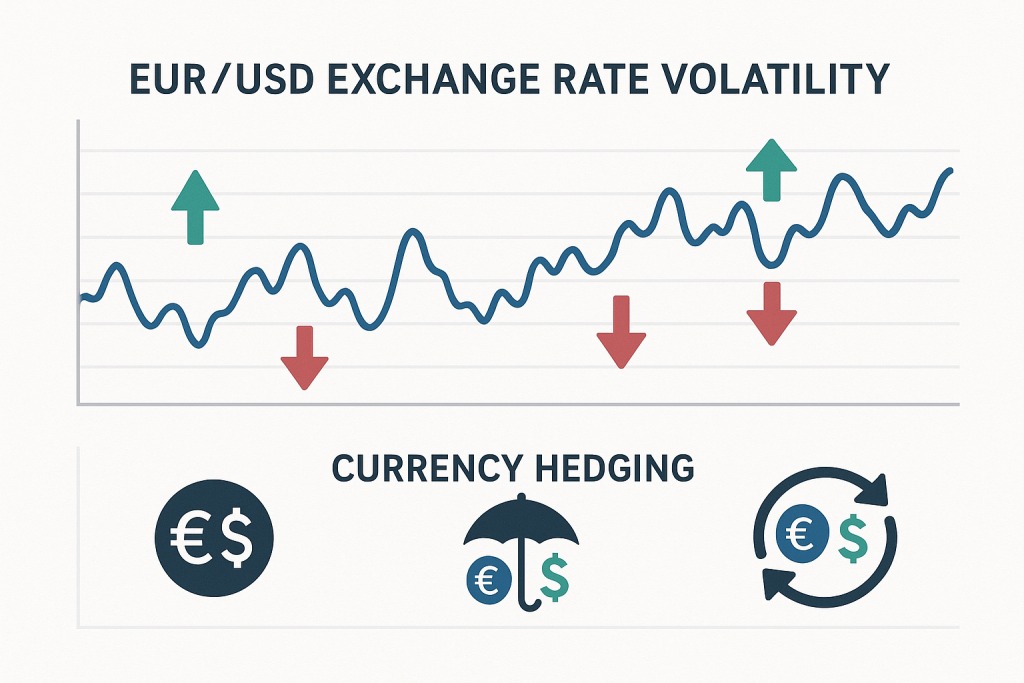
EUR/USD exchange rate volatility and currency hedging visualisation.
Currency hedging eliminates the guesswork from international investing. However, European markets represent only a fraction of global opportunities. By contrast, US stocks dominate worldwide indices. Consequently, USD exposure becomes unavoidable for diversified portfolios.
Understanding Currency Risk in ETF Investing
Currency risk hits European investors twice. For example, when you buy US assets, you bet on both the investment and the Dollar. Additionally, when converting back to Euros, exchange rate movements can wipe out gains completely.
This analysis sits within our portfolio construction & FIRE hub.
Consider this scenario. Your US ETF gains 10% in Dollar terms. Simultaneously, the Euro strengthens 8% against the Dollar. Therefore, your actual return becomes just 1.2% after currency conversion. Importantly, currency volatility often exceeds underlying asset volatility. This pattern intensifies in today’s uncertain economic environment.
The EUR/USD pair traded between 1.0257 and 1.1805 in 2025 alone. Notably, this represents potential return swings of over 15% purely from currency movements. Professional investors cannot ignore such massive volatility.
Real Impact on European Portfolios
European investors holding unhedged US assets experienced significant volatility throughout 2025. Moreover, the Euro’s strength against the Dollar created both opportunities and challenges for different hedging strategies.
Momentum-based hedging strategies showed effectiveness during the Euro’s rally. Specifically, investors who hedged during Dollar weakness preserved gains while maintaining upside potential. By contrast, carry-based hedging proved valuable when interest rate differentials favored European currencies.
Core Hedging Strategies for European Investors
Currency-Hedged ETFs
Currency-hedged ETFs represent the simplest hedging solution for retail investors. These funds use forward contracts to neutralize currency movements. Consequently, you can focus purely on underlying asset performance.
SPDR S&P 500 EUR Hedged UCITS ETF (SPPE) offers the lowest cost option at just 0.05% annually. Notably, this fund tracks the S&P 500 while hedging USD exposure back to Euros through monthly forward contracts.
iShares S&P 500 EUR Hedged UCITS ETF (IUSE) provides another excellent option with 0.20% fees and EUR 7.3 billion in assets. Importantly, BlackRock’s institutional expertise in currency management adds credibility to this offering.
Forward Contract Strategies
Forward contracts lock in future exchange rates. Therefore, they eliminate uncertainty around currency movements. In practice, professional investors use these instruments directly. By contrast, retail investors access them through hedged ETFs.
Forward pricing reflects interest rate differentials between currencies. For example, when Euro rates exceed Dollar rates, hedging provides positive carry. Currently, this differential creates modest hedging costs for European investors.
Dynamic Hedging Approaches
Dynamic hedging adjusts hedge ratios based on market conditions rather than maintaining static exposure. Crucially, this sophisticated approach can reduce hedging costs. Moreover, it preserves protection during volatile periods.
Popular EUR-Hedged ETF Options
SPPE: 0.05% TER, EUR 1.35bn AUM, monthly hedge. Additionally, IUSE: 0.20% TER, EUR 7.3bn AUM, monthly hedge. Furthermore, Amundi S&P 500 UCITS ETF Daily Hedged EUR: 0.15% TER, EUR 5.9bn AUM, daily hedge. Moreover, Xtrackers MSCI World UCITS ETF EUR Hedged and iShares MSCI World EUR Hedged UCITS ETF (IWDE) provide broader global developed-market hedged exposure.
Cost Analysis of Currency Hedging
Forward contract costs typically range from 0.05% to 0.20% annually for EUR/USD hedging. Additionally, ETF expense premiums for hedged versions average 0.10% to 0.30% above unhedged equivalents. In short, hedging breaks even when currency volatility exceeds hedging costs.
EUR-Hedged Bond ETFs: Where Hedging Matters Most
For fixed income, unhedged USD bond exposure for Euro-based investors generates currency noise. Crucially, that noise often dwarfs the bond’s actual yield. Therefore, most European fixed-income sleeves default to EUR-hedged share classes. Examples include iShares Global Aggregate Bond UCITS ETF EUR Hedged (AGGH) or Xtrackers USD Corporate Bond UCITS ETF EUR Hedged. For the broader bond playbook see our European fixed income ETFs complete guide.
The Long-Term Equity Hedge Debate (Net-Zero Argument)
For equities, research from Vanguard, Dimensional and AQR suggests currency hedging is roughly net-zero over multi-decade horizons. Notably, currencies mean-revert toward purchasing-power parity. For pure 100% VWCE-style long-horizon equity portfolios, see our 100% VWCE portfolio pros and cons and the VWCG vs VWCE comparison. Additionally, check our ETF asset allocation strategy, ETF portfolio rebalancing strategy, and all-in-one ETFs vs core-satellite.
Worth reading next: Marrying with different portfolios.
Primary Sources and Further Reading
- vanguard.co.uk/professional/product — VWCG and other hedged share-class KIDs.
- ishares.com/uk/individual — IWDE, IUSE, AGGH factsheets.
- esma.europa.eu — UCITS share-class hedging guidelines.
- bis.org/statistics/rpfx22.htm — BIS Triennial Central Bank Survey of FX turnover (EUR/USD market depth and forward pricing context).
- justetf.com — live TER, AUM and tracking difference.
- morningstar.co.uk — independent ratings.
- bogleheads.org — European hedged-vs-unhedged threads.
Frequently Asked Questions
What does it actually cost to hold a EUR-hedged S&P 500 ETF versus an unhedged one?
Headline TER premium is typically 5-20 bps. Additionally, you face interest-rate-differential carry of roughly 1.5-3% per year over 2023-2025. Notably, this occurred when USD short rates exceeded EUR rates.
What’s the difference between IWDE and IWDA for a long-term investor?
IWDA is unhedged MSCI World. By contrast, IWDE hedges to EUR via monthly forwards. In short, long-horizon totals converge; IWDE smooths the path.
Should I use a 100% hedge ratio, or only partial?
Provider research suggests 50-100% for bonds and 0-50% for equities. In practice, a common compromise involves hedging bonds fully and leaving equities unhedged.
Is equity currency hedging really net-zero in the long run?
Multi-decade AQR/Vanguard/Dimensional evidence points to mean reversion. Therefore, hedging smooths the path but does not add structural return.
When does USD hedging matter most for a Euro investor?
USD bonds, sub-7-year horizons, retirement drawdown, and multi-year EUR/USD extremes all qualify.
Are EUR-hedged ETFs UCITS compliant and safe?
Yes. Specifically, IUSE, SPPE, IWDE, Xtrackers and Amundi are all UCITS funds with segregated assets. Moreover, they fall under BaFin/AMF/CBI regulation and the ESMA framework.
Sources and further reading
- justETF — European UCITS ETF screener
- Morningstar UK ETF rankings
- ESMA — European Securities and Markets Authority
- Bogleheads wiki — EU investing
- ETF.com industry data

European UCITS/ETF investor with 11+ years building a global dividend and index portfolio, and founder of Financial Expert Class. I write every guide here from first-hand experience investing across EU brokers and tax regimes — not theory. More about me →