
ETF Tax-Loss Harvesting: Your Guide to Tax-Smart Investing
This is educational content from an EU retail investor. It is not regulated tax or investment advice. Always confirm rules with your local tax authority or a licensed adviser before harvesting losses. See our editorial process and affiliate disclosure.
Harvesting starts from an accurate cost basis — the average cost calculator gives you that number across all your purchase lots in seconds.
ETF tax-loss harvesting strategy ranks among the most powerful tools for European investors. It helps you optimize portfolio returns while minimizing tax liability. The approach lets you strategically realize losses on underperforming positions. Those losses then offset capital gains, which effectively turns market volatility into a tax advantage. European capital gains tax rates vary dramatically across countries. Therefore, mastering this strategy can save thousands of euros every year. If you are still building the foundation, start with our European ETF beginner roadmap and the UCITS ETF complete guide. Then work through this tactical layer.
Europe’s diverse tax landscape makes tax-efficient portfolio management both challenging and rewarding. Belgian investors paid no capital gains tax on passive investments until 2026 and now pay 10% above a €10,000 annual exemption. Meanwhile, their counterparts in Denmark face rates up to 42%. Understanding these differences matters a great deal. Deliberate ETF selection, lot accounting and timing can meaningfully shift your long-term wealth curve.
Understanding Europe’s Capital Gains Tax Landscape
European investors face a complex web of taxation rules. The rules vary significantly between member states. The landscape ranges from highly favourable jurisdictions to those imposing heavy burdens on investment gains. Consequently, a generic “harvest losses every December” rule breaks down at the border.
For the bigger picture, see our country-by-country ETF tax map.
How we calculate: see the tax example methodology for the exact assumptions behind these figures.
Tax Rate Variations Across Europe
The disparity in capital gains taxation across Europe is striking. Belgium exempted passive retail investors entirely until 2026; since 1 January 2026 a 10% rate applies above a €10,000 annual exemption. By contrast, countries like Ireland impose rates reaching 38% on most ETF investments under the deemed-disposal regime. France maintains a flat 31.4% Prélèvement Forfaitaire Unique. This combines income tax and social charges in one rate. Germany applies an effective ~26.375% Abgeltungsteuer plus solidarity surcharge.
To follow the forward dividend calendar and performance, I use my portfolio tracker.
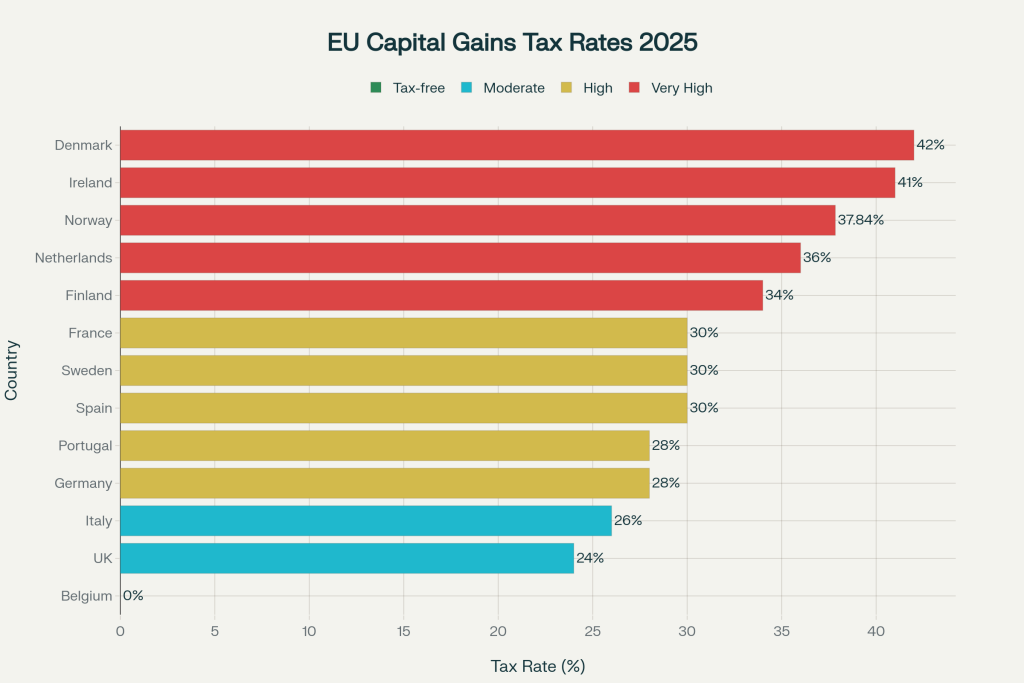
Capital Gains Tax Rates Across Europe in 2025 – Key variations affecting ETF investment strategies.
Several countries have recently adjusted their rates. For example, Spain increased its top rate from 28% to 30% in 2025. Additionally, the UK raised its maximum rate from 20% to 24%. These changes underscore the importance of staying informed about evolving tax regulations. The EU-wide framework is coordinated by ESMA. National supervisors then enforce day-to-day rules. They include BaFin in Germany, CySEC in Cyprus and the national revenue authorities.
The UCITS Advantage
UCITS ETFs domiciled in Ireland or Luxembourg offer significant advantages for European investors. Typically, these funds benefit from a reduced 15% withholding tax rate on US dividends under the relevant treaty. Compare that to 30% for direct US-domiciled ETF investments. This structural efficiency stacks on top of any harvesting strategy.
The accumulating UCITS ETF structure proves particularly useful for harvesting. Dividends reinvest inside the fund. This reduces the friction of annual distribution taxation. Meanwhile, the price-level loss stays available for crystallisation. For a deeper comparison of fund wrappers, see our notes on accumulating vs distributing ETFs, the Irish vs Luxembourg domicile guide, the ETF tax efficiency guide and our ETF portfolio rebalancing strategy playbook.
How Tax-Loss Harvesting Works for ETF Investors
The mechanics are simple in theory. You sell an ETF trading below your average cost and book the realised loss. Then you immediately redeploy the proceeds into a sufficiently different fund. That way you stay exposed to the asset class. The realised loss then offsets current-year capital gains. In many jurisdictions any excess can be carried forward.
However, no single rulebook governs the practice in Europe. The US has a bright-line 30-day “wash-sale” rule under IRS §1091. It disallows the loss if you buy a “substantially identical” security within 30 days either side of the sale. Europe has nothing as cleanly codified at EU level. Instead you get a patchwork of national rules ranging from de-facto wash-sale equivalents to no restriction at all.
Country-by-Country Loss Rules
- Ireland. Section 581 TCA 1997 contains a 4-week “bed and breakfast” rule. If you sell a security at a loss and reacquire the same security within 4 weeks, the loss is disallowed against other gains. It is only usable against a future gain on that reacquired holding. The Irish tax authority publishes the rule via Revenue.ie manuals. Switching to a genuinely different ETF (different index, different ISIN, different provider) sidesteps this.
- Germany. Losses on equity ETFs flow into the dedicated Verlustverrechnungstopf Aktien at your broker. Equity losses can only offset equity gains, not interest or dividend income. The BMF guidance is published by the Bundesministerium der Finanzen. There is no explicit wash-sale rule. However, abusive same-day round-trips can be challenged under §42 AO.
- France. Capital losses on securities can be offset against same-category gains in the year of realisation. They can also be carried forward 10 years under the rules summarised in the official BOI-RPPM-PVBMI doctrine on moins-values. France does not codify a wash-sale window for retail securities accounts. By contrast, PEA accounts have their own ring-fence.
- Netherlands. Box 3 taxes an assumed return on total assets rather than realised gains, so traditional harvesting is largely irrelevant for passive investors. Belgium was in the same position until 2026, but since 1 January 2026 gains are taxed at 10% above a €10,000 annual exemption — realised losses can be set against realised gains, so harvesting now has a purpose there where it previously had none.
- Spain, Italy, Portugal. Losses offset gains in the same category with multi-year carry-forwards (typically 4–5 years). Additionally, Spain has its own 2-month anti-abuse rule for reacquiring identical securities.
The Pair-Trade Playbook
Most EU regimes either ignore wash-sales entirely or only restrict re-buying the same security. Therefore, the practical harvesting move is the pair trade. You sell ETF A at a loss and simultaneously buy ETF B. ETF B tracks a different (but highly correlated) index. You keep market exposure, you bank the loss, and you do not breach any “substantially identical” test. The underlying index differs.
Worked pairs European investors commonly use:
- iShares Core MSCI World (IWDA, IE00B4L5Y983) swapped into SPDR MSCI ACWI IMI (SPYI, IE00B3YLTY66) or Invesco FTSE All-World (FWIA, IE000716YHJ7). Different index family (MSCI World vs ACWI IMI vs FTSE All-World), different provider, fully defensible as non-identical.
- Vanguard FTSE All-World (VWCE, IE00BK5BQT80) swapped into SPDR ACWI IMI or iShares MSCI ACWI (SSAC, IE00B6R52259).
- iShares Core S&P 500 (CSPX, IE00B5BMR087) swapped into Vanguard S&P 500 (VUAA, IE00BFMXXD54) or SPDR S&P 500 (SPPW, IE00B6YX5C33). Same index, but in regimes without a same-security wash-sale rule this is acceptable. In Ireland, switch to a different index family (e.g. MSCI USA) instead.
- EM exposure: iShares Core MSCI EM IMI (EIMI, IE00BKM4GZ66) swapped into Amundi MSCI Emerging Markets (AUEM, LU1681045370).
- Aggregate bonds: iShares Core Global Aggregate Bond (AGGG/AGGH, IE00BDBRDM35) swapped into Vanguard Global Aggregate Bond (VAGS/VAGE, IE00BG47KH54).
Verify pair selection on justETF and Morningstar. Check tracking correlation, TER, and replication method. Then cross-check against provider factsheets at iShares UK and Vanguard UK.
Lot Accounting: FIFO, LIFO and Average Cost
Which tax lots you sell determines how much loss you actually realise. Three common methods stand out:
- FIFO (First-In, First-Out). Default in Germany, Austria, and several other jurisdictions. The Abgeltungsteuer system assumes FIFO per ISIN, per sub-deposit. Often it forces you to dispose of the oldest, most-appreciated lots first. That is the opposite of what you want when harvesting.
- LIFO (Last-In, First-Out). Permitted by some brokers in specific jurisdictions, especially for managed accounts. It lets you target the most recently bought (and most-likely-underwater) lots.
- Specific identification / average cost. Common in France (average cost is the legal default for securities accounts). Also common in many UK platforms (Section 104 pooled cost). Specific-ID, where permitted, is the most powerful tool. You can hand-pick the lot with the largest unrealised loss.
In FIFO regimes the workaround is to open a second sub-account or separate broker account. The new lots then sit in their own FIFO queue. You can sell them in isolation without dragging older appreciated lots along. Bogleheads wiki entries on tax-loss harvesting cover the same principle in the US context. The logic transfers cleanly.
Swapping an Accumulator Into a Distributor (or Vice Versa)
A frequently overlooked pair-trade variant is swapping share classes. You swap an accumulating share class for a distributing share class of an otherwise comparable ETF. For example, VWCE (acc) into VHYL (FTSE All-World High Dividend Yield, dist). Or IWDA (acc) into HMWO (HSBC MSCI World, dist). The share classes track different indices or have different income mechanics. Therefore, they are clearly not “substantially identical”. Notably, you may also be repositioning toward your desired dividend yield in the same trade.
When to Harvest: Timing Triggers
Mechanical end-of-year harvesting is fine. However, the bigger gains come from harvesting opportunistically through the year. Act whenever a position drops materially below cost. Sensible triggers include:
- Position is down more than 10% versus average cost and you can identify a clean pair-trade target.
- You have a known realised gain elsewhere in the same tax year (e.g. forced redemption, employer share scheme vesting) that the loss can shelter.
- A scheduled rebalance is due. Combining the rebalance with a harvest avoids creating an extra taxable event.
- You are approaching the end of a loss carry-forward window in jurisdictions where unused losses expire (5 years in Italy, 10 years in France).
Risks, Costs and Common Mistakes
- Spread and commission drag. Two trades cost two spreads. On a thinly-traded EM ETF a 0.20% round-trip can eat half the tax benefit. Always model the after-cost figure.
- Forex friction. Switching between USD- and EUR-listed share classes of the same ETF triggers FX conversion costs at most brokers.
- Tracking divergence. Highly correlated is not perfectly correlated. Over the 30 days you sit in the replacement fund, the basket might drift versus the original.
- Re-entry timing. If you genuinely want to be back in ETF A, you must wait out the window in regimes with a same-security restriction (4 weeks in Ireland, 2 months in Spain).
- Ignoring broker reporting. Your broker may report realised P&L directly to the tax authority (Germany, Austria, Italy). In that case, the harvest only “counts” if it is reflected on the year-end statement.
- Confusing dividend distributions with capital gains. Losses generally cannot offset dividend income in Germany’s Verlusttopf split. Check the category before assuming.
Frequently Asked Questions
Does the EU have a wash-sale rule like the US §1091?
No. There is no EU-wide wash-sale rule equivalent to the US IRS §1091 30-day “substantially identical” test. Each member state sets its own rule. For example, Ireland has a 4-week same-security rule under Section 581 TCA 1997. Spain has a 2-month rule. By contrast, many others (France, Germany, the Netherlands) have no explicit wash-sale window for retail securities accounts. Always confirm with your local tax authority before assuming a US-style rule applies.
What is the 30-day (4-week) rule in Ireland and how do I work around it?
Irish CGT rules disallow a loss if you sell a security and buy the same security back within 4 weeks (Section 581 TCA 1997, documented by Revenue.ie). However, the loss is not lost forever. It attaches to the reacquired holding and is usable when you eventually sell that. The straightforward workaround is to redeploy into a clearly different ETF. Pick a different index family (MSCI World → FTSE All-World), different provider, different ISIN. For example, selling IWDA at a loss and buying SPDR MSCI ACWI IMI is defensible as non-identical.
How does the German Verlustverrechnungstopf actually work?
Under German Abgeltungsteuer, your broker maintains two loss buckets per tax ID. One is an Aktien pot (losses from individual shares). The other is a Sonstige pot (everything else including ETF losses, bond losses, and option losses). Equity-fund losses generally flow into the Sonstige pot. They can offset most investment income including ETF capital gains and dividends. Losses net at the broker automatically and excess losses carry forward indefinitely. However, you must request a Verlustbescheinigung by 15 December if you want to net losses across brokers in your tax return. Full BMF guidance is published by the Bundesministerium der Finanzen.
Can I swap an accumulating ETF for a distributing version of the same fund?
Yes, and this is one of the cleanest harvesting moves in jurisdictions with a same-security rule. An accumulating share class (e.g. VWCE) and a distributing share class of a comparable fund (e.g. VHYL or HMWO) have different ISINs. They have different distribution policies and often different underlying indices. Therefore, they are not “substantially identical” under any EU national rule. The trade-off is that you may temporarily change your dividend cash-flow profile. Additionally, your tax treatment of distributions may shift. Model the post-tax outcome on justETF first.
LIFO or FIFO — which lot method is best for harvesting?
If your jurisdiction allows specific identification, use it. France’s average-cost system, the UK’s Section 104 pool with bed-and-breakfast restrictions, or broker-permitted Specific-ID all work. Hand-pick the lot with the largest unrealised loss. By contrast, if you are stuck with FIFO (Germany, Austria), LIFO is not available. The workaround is to open a separate sub-account. Newer (likely loss-bearing) lots then sit in their own FIFO queue, isolated from older appreciated lots. Always check what your broker actually reports to the tax authority. The legal default and the broker default are not always the same.
Can you walk through a concrete IWDA → SWRD pair-trade?
Suppose you hold 100 shares of IWDA (iShares Core MSCI World, IE00B4L5Y983) bought at €80, now trading at €68. Unrealised loss: €1,200. You sell all 100 IWDA shares at €68. Immediately you buy SWRD (SPDR MSCI World UCITS ETF, IE00BFY0GT14) with the proceeds. Both track developed-market equities. However, the issuer, index methodology and ISIN are different. That is clean separation. You bank the €1,200 realised loss against current-year gains (or carry it forward). After the relevant waiting window (4 weeks in Ireland, none in Germany or France), you can switch back to IWDA if you prefer the original. Run the numbers including spread, commission and FX on Morningstar or ETF.com before placing the trade.
Putting It Together
Tax-loss harvesting is not a way to make money. It is a way to keep more of the money the market eventually returns to you. The discipline is worth more than the cleverness. A documented pair-trade list, a sensible lot-accounting plan, and a yearly check-in are enough to capture most of the benefit. For wider portfolio context, our balanced ETF portfolio guide and the European broker hub explain where harvesting fits into the broader operating model.
Educational disclaimer. Written by Kestutis Balciunas, an EU retail investor, not an FCA-regulated adviser. Tax rules change and apply differently per individual. Verify every step with your local tax authority or a licensed adviser before acting. See help & FAQ.

European UCITS/ETF investor with 11+ years building a global dividend and index portfolio, and founder of Financial Expert Class. I write every guide here from first-hand experience investing across EU brokers and tax regimes — not theory. More about me →