
The ISK ETF Sweden 2026 account is one of the cleverest tax wrappers in the European Union — and the single biggest reason Sweden has one of the highest retail investing participation rates on the continent. The Investeringssparkonto (ISK) replaces capital gains and dividend taxation with a simple flat annual levy based on a deemed return (schablonintäkt). For UCITS ETF investors who beat the deemed rate, the ISK is remarkably tax-efficient. This guide walks through exactly how the schablonintäkt is calculated in 2026 and when the ISK beats a regular taxable account.
I’ve followed the Swedish ISK system closely because it’s the model many other EU countries are studying. The mechanic is elegant: no tracking of individual gains, no capital gains tax events, just one annual flat levy. For a long-term equity DCA investor, it’s close to ideal. But — and this is the part many enthusiastic ISK guides gloss over — the wrapper is not free money. It is a bet: you wager that your portfolio will out-earn a government reference rate. Win the bet and the ISK is brilliant. Lose it, and you can end up paying tax in a year where a conventional account would have charged you nothing.
Once the ISK makes sense, pick your platform with my Swedish broker guide.
What the ISK actually is
Table of Contents
Browse the full series in our ETF taxes in Europe by country.
Methodology: the calculations in this guide apply our tax example methodology.
The Investeringssparkonto (ISK) is a Swedish investment account wrapper introduced in 2012. Instead of taxing your actual capital gains and dividends, the ISK applies a flat annual tax based on a “schablonintäkt” — a standardized deemed return calculated from your account value and the government reference rate.
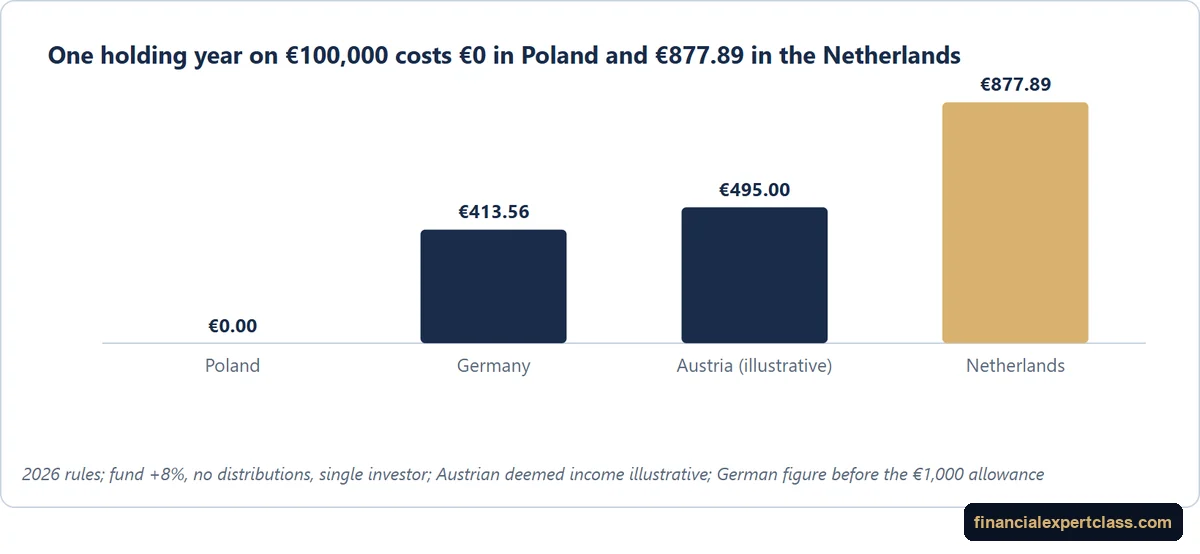
Every European country taxes ETFs in one of four ways. One map shows which is yours, and why the same €100,000 ETF costs €0 a year in Poland and €877.89 in the Netherlands. The full lesson, free, no sign-up.
The defining features:
- No capital gains tax — you can buy and sell UCITS inside the ISK freely without triggering any tax event. Rebalancing is completely tax-free.
- No dividend tax — dividends received inside the ISK are not separately taxed.
- One annual flat levy — the schablonintäkt, calculated from your account value and the statslåneränta (government borrowing rate). From 1 January 2026 the first SEK 300,000 of savings is exempt from it.
- No contribution cap — unlike the French PEA (€150,000) or UK ISA (£20,000/year), the Swedish ISK has no upper limit.
- No declaration of individual trades — you don’t report each buy and sell. Skatteverket receives a single capital-base figure from your broker, and the standardised charge is pre-filled on your tax return.
That last point is the quiet superpower of the ISK. Inside a conventional Swedish capital-gains account (a depå, also called an aktie- or fondkonto), every disposal is a taxable event you must reconcile. Inside the ISK, the wrapper does not care what you traded, when, or at what price. It only measures how much money sat in the account. The administrative saving alone converts many reluctant investors into active ones.
The 2026 schablonintäkt calculation
The schablonintäkt is calculated in a specific way (verify current figures with Skatteverket):
- Capital base: the average of your account value at the start of each quarter, plus deposits made during the year.
- Deemed return rate: the statslåneränta (government borrowing rate) as of 30 November of the previous year, plus 1 percentage point — with a floor of 1.25%. The statslåneränta was 2.55% on 30 November 2025, so the rate for 2026 is 3.55%.
- Tax-free base — new for 2026: the first SEK 300,000 of savings escapes the levy entirely. Skatteverket applies it as a deduction of up to 300,000 × the deemed rate, so only the part of your capital base above SEK 300,000 is charged. The base was SEK 150,000 for 2025 and doubled on 1 January 2026. It is one allowance per person, shared across your ISK, kapitalförsäkring and PEPP savings, and the ISK is deducted first.
- Tax rate: 30% applied to the schablonintäkt (deemed return) — which works out at 1.065% a year on the amount above the tax-free base in 2026.
The mechanic is worth restating plainly because it confuses newcomers: the ISK does not tax your gains. It taxes a presumed gain that the state assumes you earned, whether you actually earned it or not. If equities crash and your account loses a third of its value, the schablonintäkt is still calculated on the (now larger, historic) quarterly capital base, and you still owe the 30% levy on that deemed figure. There is no “I lost money this year, so I owe nothing” relief inside an ISK.
Nordic neighbour: how Norway taxes ETFs through the aksjesparekonto.
Worked example for a Swedish resident with an average ISK capital base of 1,000,000 SEK (roughly €88,000) in 2026, using the real figures: the statslåneränta was 2.55% on 30 November 2025, so the deemed rate is 2.55% + 1.0% = 3.55%, and the first 300,000 SEK is free:
- Schablonintäkt = 1,000,000 SEK × 3.55% = 35,500 SEK
- Tax-free deduction = 300,000 SEK × 3.55% = 10,650 SEK
- Taxable schablonintäkt = 35,500 − 10,650 = 24,850 SEK
- ISK tax = 24,850 SEK × 30% = 7,455 SEK (roughly €650)
So a Swedish resident with a 1,000,000 SEK ISK pays about 7,455 SEK in annual ISK tax — roughly 0.75% of the account value — regardless of whether the portfolio rose 20% or fell 10%. To model this flat annual drag against your assumed return, the compound growth calculator lets you subtract a fixed percentage each year, mirroring how the ISK behaves.
Note how the effective drag shrinks as the deemed rate falls — and how much the tax-free base now softens it. At the 1.25% floor, the same million-krona account would owe only 700,000 × 1.25% × 30% = 2,625 SEK — about 0.26% of value. In a high-rate environment, with a statslåneränta of, say, 3.5% (deemed 4.5%), the same account owes 700,000 × 4.5% × 30% = 9,450 SEK, or 0.95%. The ISK is therefore not a fixed cost: it tracks the interest-rate cycle, and it bites harder precisely when rates are high.
ISK versus a conventional capital-gains account
The single decision every Swedish investor faces is: ISK or a conventional depå (aktie-/fondkonto)? The two are taxed on entirely different principles. The ISK taxes a deemed return on the balance; the depå taxes your actual realised profit at 30%, and — crucially — lets you deduct realised losses. The table below summarises the trade-offs (figures illustrative; verify current rates with Skatteverket).
| Feature | ISK (Investeringssparkonto) | Depå (conventional capital-gains account) |
|---|---|---|
| How taxed | Flat 30% on a deemed return (schablonintäkt) based on account value | 30% on actual realised capital gains and dividends |
| Tax in a loss year | Still owed — levy applies regardless of performance | Zero if you realise nothing; losses are deductible |
| Loss offset | Not possible — losses cannot reduce the schablon charge | Realised losses offset gains (typically 70% of net losses creditable) |
| Rebalancing | Tax-free — sell and switch at will | Each sale is a taxable event |
| Admin / declaration | Pre-filled; no per-trade reporting | Every disposal reconciled on the return |
| When it wins | High-return years; active rebalancing; long equity holding periods | Low-return or loss years; low-turnover buy-and-hold; harvesting losses |
The headline is the asymmetry. The depå rewards you with relief in bad years; the ISK never does. The ISK rewards you in good years by capping the bill at a deemed return well below realistic equity gains. Over a full cycle, equities spend far more time above the deemed rate than below it — which is why the ISK wins for most long-horizon investors. But it is a probabilistic edge, not a guarantee.
When the ISK beats a taxable account
Like the Dutch Box 3, the ISK’s flat-levy structure rewards investors who beat the deemed rate. The breakeven logic:
- If your UCITS returns more than the deemed rate (3.55% in 2026), the ISK is more tax-efficient than a regular account — you keep the outperformance with only the flat levy applied.
- If your portfolio returns less than the deemed rate, a regular taxable account (where you’d only pay tax on actual gains) could be cheaper.
- For long-term equity investors, expected returns of 6-8% comfortably exceed the deemed rate, making the ISK clearly advantageous.
This is why Swedish equity investors overwhelmingly use the ISK. For a long-term VWCE holder, the tax-free rebalancing plus the modest flat levy beats capital gains taxation in almost every realistic scenario. The regular taxable account (where Sweden charges 30% on actual gains) only wins for very low-return or short-term holdings. For the broader picture of how wrapper choice interacts with fund domicile and share class, my ETF tax efficiency guide sets out the full framework, and the ETF fee calculator helps you weigh the flat schablon drag against fund costs in one place.
Once you hold a few funds, it helps to see the whole picture — here is the tracker I use to follow my dividends.
Worked example: ISK levy versus capital-gains tax, same portfolio
Abstractions only get you so far, so let me run the two regimes side by side on one portfolio. Take an investor — call her Elin — holding 1,000,000 SEK of a global equity UCITS for a full year, at the 2026 deemed rate of 3.55% with the first 300,000 SEK free. I’ll compare three return scenarios (illustrative figures; verify rates with Skatteverket).
| Scenario | ISK levy (flat) | Depå tax (30% of realised gain) | Cheaper wrapper |
|---|---|---|---|
| Portfolio +15% (150,000 SEK gain), all realised | 7,455 SEK | 45,000 SEK | ISK (saves 37,545 SEK) |
| Portfolio +2% (20,000 SEK gain), all realised | 7,455 SEK | 6,000 SEK | Depå (saves 1,455 SEK) |
| Portfolio −10% (100,000 SEK loss), realised | 7,455 SEK | 0 SEK (plus a deductible loss) | Depå (saves 7,455 SEK + relief) |
The pattern is stark. In the strong year the ISK is dramatically cheaper — 7,455 SEK against 45,000 SEK. In the modest +2% year the depå edges ahead because actual gains were small. And in the loss year the ISK is genuinely punishing: it charges 7,455 SEK while the depå charges nothing and hands Elin a deductible loss she can carry against future gains. If you expect a string of weak years — early retirement drawdown, a deliberately conservative bond-heavy mix — the ISK’s “always-on” levy is a real cost to weigh.
You cannot offset losses in an ISK
This deserves its own section because it is the most under-appreciated weakness of the wrapper. In a conventional depå, a realised loss is an asset: Sweden lets you set net capital losses against capital gains (broadly, 70% of an unrelieved net loss reduces other taxable capital income). That makes deliberate ETF tax-loss harvesting a viable strategy in a taxable account.
Inside an ISK, that lever simply does not exist. There are no realised gains or losses to report, so there is nothing to harvest and nothing to carry forward. If 2026 turns out to be a brutal equity year, the depå investor banks a usable tax loss; the ISK investor banks nothing but the schablon bill. For investors who run a barbell — equities in the ISK, a separate taxable sleeve for tactical positions — keeping a loss-harvestable account outside the ISK is a deliberate, sensible choice rather than an oversight.
ISK vs KF (Kapitalförsäkring)
Sweden has a second similar wrapper, the Kapitalförsäkring (KF) — an insurance-based account with similar schablon taxation. The key differences:
- ISK: you own the securities directly; you have voting rights; foreign withholding tax on dividends may be reclaimable; simpler for most investors.
- KF: the insurance company owns the securities; no voting rights; foreign withholding is handled by the insurer (sometimes more efficiently for foreign dividends); useful for specific estate-planning or beneficiary scenarios.
For most Swedish UCITS investors, the ISK is the default choice. The KF makes sense mainly for those who want simplified foreign-dividend handling or specific beneficiary designation. The underlying schablon math is similar for both — and so, importantly, is the inability to harvest losses.
Accumulating vs distributing for Swedish residents
Inside an ISK, the accumulating-vs-distributing choice is largely irrelevant for tax purposes — dividends aren’t separately taxed, and there’s no capital gains event on sale. This makes the ISK similar to the Dutch Box 3 in simplifying the share-class decision.
One subtlety: for foreign-domiciled UCITS held in an ISK, the underlying 15% US withholding tax on US-equity dividends (via the Ireland-US treaty) still applies inside the fund. Sweden’s tax treaty network means some of this foreign withholding may be creditable. The accumulating vs distributing UCITS guide covers the broader context, and the ETF withholding tax calculator shows the layered effect. When you are comparing two near-identical world trackers and the share class no longer matters for tax, the deciding factor becomes total cost and tracking quality — exactly what the compare UCITS ETFs tool is built to surface.
Five ISK strategies for Swedish investors
- Hold high-expected-return equity UCITS in the ISK. The flat levy rewards beating the deemed rate — equity is the natural fit.
- Rebalance freely. No capital gains tax inside the ISK means you can rebalance as often as you like without tax friction. The ETF rebalancing cost calculator models the (broker-fee-only) cost of staying on target.
- Time large deposits carefully. Deposits during the year increase the schablon base. Avoid making large deposits right before a quarter-end measurement date if you can deposit just after instead.
- Use the ISK for your core equity portfolio. Keep only cash and short-term needs outside it.
- Consider the deemed-rate floor. When government rates are very low, the 1.25% floor sets the minimum deemed return — still typically far below realistic equity returns.
Common mistakes Swedish ISK investors make
Having watched friends and readers run ISKs for over a decade, the same errors recur:
- Parking cash in the ISK. The schablon charge applies to the whole balance, cash included. Idle krona earning nothing still attract the deemed-return levy — a guaranteed drag with no upside. Keep cash in a sparkonto, not the ISK.
- Holding low-return bond funds in the ISK. If the holding’s expected return sits below the deemed rate, you are paying tax on a return you may not earn. Short-dated bonds and money-market funds often belong in a depå.
- Front-loading deposits before a quarter-end. Because the capital base measures value at the start of each quarter, a large transfer landing on 31 December versus 1 January can needlessly inflate the following year’s base.
- Assuming the ISK is always cheaper. In a sustained low-return or loss period — see the worked example — a depå can win. The ISK is a probabilistic bet on beating the reference rate, not a free lunch.
- Forgetting the lost loss-offset. Investors who run concentrated or volatile positions inside an ISK give up the ability to harvest losses. For tactical, high-variance holdings, a taxable account may serve better.
Key takeaways
- The ISK taxes a deemed return (schablonintäkt) on your account value, not your actual gains — 30% of the statslåneränta + 1 percentage point, with a 1.25% floor. For 2026 that is 3.55%, so 1.065% a year, and the first SEK 300,000 of savings is exempt.
- No per-trade declaration, no capital gains tax, no dividend tax, and no contribution cap make it administratively effortless.
- The ISK wins in high-return years and for active rebalancers; a conventional depå can win in low-return or loss years because it taxes only realised gains.
- You cannot offset losses inside an ISK, and you still pay the levy in a losing year — the wrapper’s biggest weakness.
- Always verify the current standardised rate with Skatteverket before filing; the deemed rate moves with the interest-rate cycle.
FAQ
Q: Is there a contribution limit on the ISK?
A: No. Unlike the French PEA or UK ISA, the Swedish ISK has no upper contribution limit. You can hold an unlimited amount. There is now a tax-free base, though, which is a different thing: from 1 January 2026 the first SEK 300,000 of savings carries no levy at all (it was SEK 150,000 in 2025).
Q: Do I pay tax when I sell UCITS inside the ISK?
A: No. There’s no capital gains tax inside the ISK. You pay only the annual schablon levy on the deemed return. Selling is tax-free.
Q: Can I hold foreign UCITS like VWCE in an ISK?
A: Yes — Irish-domiciled UCITS like VWCE, IWDA, and VUAA can be held in an ISK through Swedish brokers (Avanza, Nordnet) that offer the wrapper.
Q: How does the ISK compare to the Dutch Box 3?
A: Both tax deemed returns rather than actual gains. The ISK’s deemed rate is typically lower (linked to government borrowing rate + 1%), making it often more favourable than Box 3’s ~6% investment rate.
Q: What happens to foreign dividend withholding inside an ISK?
A: The underlying fund-level US withholding still applies. Sweden’s treaty network means some foreign withholding on directly-held foreign shares may be creditable, but for fund-level withholding inside a UCITS it’s structural leakage.
Q: Do I pay ISK tax in a year my portfolio loses money?
A: Yes. The schablon levy is based on your account value and the deemed rate, not on performance. Even in a losing year you owe the flat charge — and unlike a depå, you cannot deduct the loss.
Q: Can I harvest tax losses inside an ISK?
A: No. There are no realised gains or losses to report inside an ISK, so there is nothing to harvest. If loss harvesting matters to you, keep those positions in a conventional depå.
Q: Should I hold cash or bond funds in my ISK?
A: Usually not. The schablon charge applies to the whole balance, so low-return holdings can cost more in levy than they earn. Cash typically belongs in a sparkonto and low-yield bonds may sit better in a depå.
Q: When is a conventional depå better than an ISK?
A: In sustained low-return or loss years, for very short holding periods, or when you specifically want to harvest realised losses. For long-horizon equity investing, the ISK usually wins.
Q: Where do I find the exact rate to use for 2026?
A: From Skatteverket. The deemed rate is set from the statslåneränta on 30 November of the previous year plus one percentage point, floored at 1.25%. The statslåneränta was 2.55% on 30 November 2025, so the 2026 rate is 3.55% and the tax is 1.065% of the capital base above the SEK 300,000 tax-free level. Always confirm the current standardised rate with Skatteverket before filing.
The bottom line
For a Swedish UCITS investor in 2026: use the ISK for your core equity portfolio. The flat schablon levy plus tax-free rebalancing makes it dramatically more efficient than a regular taxable account for any long-term equity investor who beats the deemed rate (which equity comfortably does over time). There’s no contribution cap, so it can hold your entire portfolio. Just keep cash and low-return holdings elsewhere, and remember the wrapper offers no relief in a loss year. For broker selection, the best broker for Swedish investors 2026 guide compares Avanza, Nordnet, and IBKR. To translate your ISK balance into a sustainable retirement-income number, the financial freedom calculator runs the withdrawal math.
Cited authorities for Swedish ISK taxation: Skatteverket, Finansinspektionen, and Riksbank. Verify the current statslåneränta and schablon rate before filing.

European UCITS/ETF investor with 11+ years building a global dividend and index portfolio, and founder of Financial Expert Class. I write every guide here from first-hand experience investing across EU brokers and tax regimes — not theory. More about me →